Monday, November 9, 2026

The World Priced in Eggs: Food Got Four Times Cheaper, Homes Never Did, and Silver Is Flashing a 1980-Style Warning

The World Priced in Eggs: Food Got Four Times Cheaper, Homes Never Did, and Silver Is Flashing a 1980-Style Warning

By Daniil Tkachev · Original research at dantweb.dev


Seventy years ago a hen's egg in Washington, Cairo and Bangkok was the same object it is today. That makes it one of the few honest yardsticks in economics. Price income, homes, cars and silver in eggs, and you can compare 1970 with 2025, or India with Norway, without exchange rates or inflation adjustments getting in the way. A new study, The World Priced in Eggs, does exactly that for 20 countries from 1950 to 2025, using FAO, World Bank, ILO, BIS, US Bureau of Labor Statistics and Eurostat data. Its findings cut through a lot of noise. Food got about four times cheaper relative to income. Factory goods got dramatically cheaper everywhere. Homes did not. Silver went nowhere for 70 years and is now at one of its most extreme readings on record. And the rich world stopped getting richer in eggs around 2005. The thesis is that the egg exposes the real dividing line in the global economy: things that can be made in a factory keep getting cheaper, while things tied to land and money do not, and today the second group is flashing the same warnings it showed before past crises.


Source: all figures and charts below come from the research report The World Priced in Eggs: Egg purchasing power, 20 countries, 1950–2025 (November 2026). The charts link to the report's full-size SVG versions.


Food became four times cheaper, fastest where people were poorest


In the median country, one month of average income bought 4,136 eggs around 1970, 12,069 around 2000 and 16,592 in 2024. That is as much a story of farm productivity as of income: industrial poultry, cheap feed grain and refrigerated logistics turned the egg from a luxury into the cheapest animal protein on earth.


The gains were largest where incomes started lowest. Between 1970 and 2024 egg purchasing power rose 25 times in Chile, 14 times in India and 11 times in Thailand, against 4.4 times in France and 2.4 times in the United States. China went from 640 eggs a month in 1991 to more than 12,000. The gap between the best- and worst-placed country fell from 64 times in 1970 to 27 times in 2024. But the order barely moved: Norway, the US, Britain and Western Europe stayed on top for the whole period, and India and Egypt stayed at the bottom.


Small-multiples chart: eggs one month of income buys in 20 countries, 1950–2025Eggs one month of income buys, by country, 1950–2025. Source: The World Priced in Eggs (full-size SVG).

The rich world's plateau


The most uncomfortable finding for advanced economies is that most of them peaked between 2003 and 2007 and are now below that level. Against its peak year, the United States stands at 22%, Greece at 53%, Japan at 56%, Germany at 59% and France at 62%. Three forces combined. Eggs got dearer: the US farm price per egg rose from $0.038 in 2000 to $0.22 in 2024, nearly six times, while income per head rose 2.3 times, with avian flu, the EU's battery-cage ban and feed spikes all playing a part. Income growth slowed after 2008. And crises cut deep: Greece lost almost half its egg purchasing power between 2006 and 2013.


Between 2020 and 2025 the squeeze sharpened. In the US the farm price of an egg rose 3.5 times while income rose 1.38 times. In most developing countries income won. The report's reading is that this kind of everyday squeeze "fuels political pressure more than it predicts recessions", which fits the voter anger over prices seen across rich democracies.


Factory goods: the great deflation


A compact family car got cheaper in months of income in every country in the data, without exception. In the US it fell from 15.2 months of average income in 1970 to 3.1 in 2024. In India it fell from 189 months to 37, in Poland from 115 months in 1990 to 14, and in China from 69 months in 2005 to 16.


The car is also the most equal measure in the study. Income measured in eggs still varies 27 times between countries, but the egg price of a car varies only about 6 times, and has for 50 years. A car is traded on world markets, so its price converges. Eggs, wages and land are local, so they do not. For anyone in e-commerce, that is the long-run engine behind cheaper goods: global supply chains, automation and competition, now led by Chinese factories, which the report says are still "exporting lower prices to the world".


Small-multiples chart: how many eggs a compact family car costs in 20 countriesHow many eggs a compact family car costs, by country. Source: The World Priced in Eggs (full-size SVG).

Homes are the one big thing that did not get cheaper


Measured in years of average income, a 100 m² home costs about the same as a generation ago, or more. France is the clearest case: 10.6 years in 1975 and 10.8 in 2024, through two property booms. Britain went from 5.2 to 7.9 years, Norway from 3.7 to 5.0 and Poland from 5.4 in 2005 to 9.3. Homes got cheaper only where a bubble burst or incomes outran everything: Japan from about 31 years to 17, Germany from 21 to 10, China from 44 in 2005 to 11.


The report's explanation is simple: "A car factory can double its output; a city cannot double its land." As incomes rose, buyers bid more for the same locations, so income gains were absorbed into land prices instead of making homes cheaper.


Small-multiples chart: how many eggs a 100 square-metre home costs by countryHow many eggs a 100 m² home costs, by country. Solid lines are observed prices, dashed lines are chained from an index. Source: The World Priced in Eggs (full-size SVG).

Silver: 70 years without a trend, and an extreme reading now


Average monthly income in the median country bought 2.2 kg of sterling silver in 1970 and 2.0 kg in 2024. In between it collapsed to 0.65 kg in 1980, rose to nearly 4 kg around 2000 and fell again in the 2011 and 2025 rallies. Unlike eggs or cars, silver isn't made cheaper by productivity. It behaves as a store of value whose price rises with money and wealth, which is why every country dips at the same moment in 1980.


The outlook is where silver matters. With silver averaging about $72 an ounce from January to October 2026, against $39.8 in 2025, the report estimates a month of median income will buy about 0.9 kg in 2026, the second-lowest reading on record. The only lower years cluster around 1979–83 and 2011–12, both moments of fear about money and debt. In both cases the silver price then fell and silver purchasing power recovered 2.5 to 3 times within about five years. The 2026 drop from a $92 peak in January to $57 by October has the same shape. As the report puts it: "Two cases are a pattern, not a law." For readers who follow bitcoin and gold as hedges, silver's history is a reminder that fear trades have tended to unwind once the panic about money fades.


Small-multiples chart: grams of sterling silver one month of income buys by country, log scaleGrams of sterling silver one month of income buys, by country (log scale). Source: The World Priced in Eggs (full-size SVG; also available in pounds per year).

A working month priced in silver: 1900 versus today


Silver also allows a longer look back than the egg data, because until 1920 British money was itself made of sterling silver: every shilling contained 5.655 grams of it. Around 1900, roughly £100 a year, about £2 a week, was a good income for a skilled engineering worker in Britain. (An 1886 Board of Trade wage census put a fitter's average at 26 shillings a week, and rates rose from there.) £100 was 2,000 shillings, or about 11.3 kg of sterling silver a year, which is roughly 0.94 kg a month.


Now put that next to the report's numbers. A month of median income bought 2.2 kg of sterling silver in 1970, 2.0 kg in 2024, and an estimated 0.9 kg in 2026. Measured in the metal money used to be made of, a working month costs about what it did when a skilled British engineer earned £100 a year. The UK's own 2025 reading in the report, about 3.8 kg a month, is higher, but still within the same small range, while in eggs or cars the same month buys many times more than it did. The comparison is rough: a skilled worker's wage in 1900 is not the same thing as income per head today. But the direction is clear. The price of labour in money that cannot be printed has barely moved in 125 years. What changed is everything that labour can buy that factories and farms learned to make cheaply.


Four warning lights, and three scenarios


The report is careful about what this data can and cannot do: it cannot give a date for the next crisis. It can show where today's readings sit against their own history. Four stand out:


- Silver at a historic extreme, as above.
- Housing stretched in some countries. Mexico is at a record 12.1 years of income for 100 m², and Norway, the US, Britain and Chile are near their own highs. In this data set, a country's own housing peak has repeatedly come shortly before its crisis: Japan before 1990, the US in 2005, Greece in 2006, Russia in 2007, Brazil in 2012. China is the opposite case, already deflated to the cheapest level in its record.
- A food-price squeeze in rich countries, as eggs outpaced incomes in the US, Japan, Germany and France since 2020.
- The tailwind: cars kept getting cheaper in every country between 2014 and 2024, and India, Egypt, Thailand, Chile and Russia hit records in egg purchasing power in 2025.

From these, the report sets out three scenarios, explicitly as judgments rather than forecasts. Most likely for 2026–2028 is "an unwind and a cooling, not a collapse": the metals spike keeps deflating and growth slows where housing is stretched and debt is high. The global-crisis path requires several lights to turn red together, such as a sharp housing correction in a stretched market combined with high interest rates, or Chinese property deflation hitting commodity exporters. The third is a new prosperity wave in the 2030s led by India, Southeast Asia and Central Europe.


Where AI fits


The report's most interesting line for technology readers is about the rich world. A renewed rise in rich countries' purchasing power "would need a productivity wave, possibly from AI", and if one comes, "the first sign would be eggs per month climbing again in the US, Japan and Europe after twenty flat years". That gives a concrete test for the AI boom that is more useful than valuations or token counts. So far, the evidence of AI productivity is in company reports and benchmarks, not in household purchasing power. If AI does for services what factories did for cars, it should eventually show up in what an average month of income buys. Until it does, the egg says the rich world is still waiting.


What to watch


- Silver purchasing power: a rebound towards 1.8–2 kg a month would mean the fear trade has unwound, as after 1980 and 2011.
- Years of income for a home in the US, UK and Norway (2.3, 7.7 and 5.1 now): a turn down from these highs has preceded crises before; a flat plateau is the benign case.
- Eggs per month in the US, Japan and France (22%, 56% and 62% of peak): a rise would be the first sign of a rich-world productivity revival.
- Months of income for a car in India and Egypt (37 and 120): continued falls mean convergence is still working.

How far to trust it


The method is transparent and its limits are stated. Egg prices are farm-gate prices, not shop prices, which typically run 1.5 to 3 times higher; that shifts levels but not trends. Income is GNI per head, including children, not wages. Some housing and car anchors are rough, and level comparisons between countries are less reliable than trends within one. Every estimated value is labelled in the dataset, and corrections are declared rather than hidden. The full study, built with the open datavibes toolkit, includes the data sources, method notes and all seven charts, including the graduate pay and urban pay series: read the report.


The read


Priced in eggs, the last 70 years split cleanly in two. What can be manufactured and traded, food and factory goods, became far more affordable everywhere, and poorer countries closed half the gap. What is local and scarce, land and the stores of value people run to when they fear for their money, did not get cheaper at all, and both are now at stretched readings that have come before trouble in the past. The egg cannot say when. But it does suggest where to look: at housing in the stretched markets, at whether the silver panic keeps unwinding, and at whether AI ever makes the rich world's eggs-per-month line move again.


The engine: datavibes, and how to build your own study


Every number and chart in the egg report was produced by datavibes, an open, config-driven Python toolkit for building datasets, available on GitHub at github.com/dantweb/datavibes. Nothing in the study was edited by hand in a spreadsheet. The whole analysis is one declarative file that lists its sources, its processing steps, its schema and its outputs, and one command, datavibes run egg-purchasing-power, fetches the data, processes it and writes the CSV, the Excel workbook and all seven SVG charts with a shared timestamp.


That design is what makes the results checkable, which matters more than ever when so much "research" is generated in seconds:


- Provenance in the data. Every estimated value is labelled in its own column, as observed, index-chained or anchored, and every anchor carries its source and a confidence level.
- Corrections are declared, not hidden. Each unit fix or exclusion is a line in the configuration with its reason, printed as a warning on every run.
- Assumptions are parameters. Change one variable, such as the weight of an egg, and the entire study reruns with the new assumption.
- Tests. The egg study is covered by 41 automated tests that replay the pipeline on recorded data, so a code change that alters a result is caught.

Because a study is a declaration rather than a one-off script, extending it is mostly editing YAML. The building blocks written for this report, including sources for FAOSTAT, the World Bank, ILOSTAT, BIS, the US Bureau of Labor Statistics and Eurostat, index chaining, spreadsheet output, small-multiples charts and world maps, are reusable for any other dataset. The report suggests where to go next: price the world in rice, milk or wheat instead of eggs, add countries such as Nigeria, Indonesia or Vietnam, switch from farm-gate to shop prices, measure prices in hours of work, or turn the four warning lights into a tracker that recalculates every month.


Getting started takes a few commands:


git clone https://github.com/dantweb/datavibes
cd datavibes && pip install -e .
datavibes new my-study --category economy
datavibes validate my-study
datavibes run my-study

datavibes can be run from the command line or a scheduled job, or imported as a Python library. Its timestamped outputs are designed to be served directly by data products, including the dataset plugin of the VBWD platform. It is released under the Business Source License 1.1: free for research, evaluation and non-commercial work, and for production use by organisations with annual revenue below the value of one bitcoin. Anyone who wants to check the egg numbers, challenge an assumption or build their own yardstick can start at the datavibes repository on GitHub, then compare their results with the original report.


Written for Red Robot with AI assistance and human editing. Based on the research report The World Priced in Eggs (November 2026), with the 1900 wage comparison added from UK historical wage records and coinage standards, and the report itself built from FAOSTAT, World Bank, ILOSTAT, BIS, US BLS and Eurostat data. datavibes and the report share the same author. The scenarios described are the report's judgments, not forecasts or investment advice.

https://redrobot.online/2026/11/08/the-world-priced-in-eggs-food-got-four-times-cheaper-homes-never-did-silver-flashes-a-warning/

Tuesday, October 6, 2026


The Fax-Era Ceiling: How Old-School Management Holds Back German IT
German IT is not short of talent; it is short of decision-makers who understand what they control. Japan shows what happens when a country's resources sit with people who can no longer put them to work. Germany is running the same experiment with something just as valuable: authority over technology.

In Japan, the frozen asset is money. Bloomberg reports that seniors with cognitive decline control about ¥315 trillion, close to half of GDP, and much of it simply sits idle. In Germany, the frozen asset is decision-making. Budgets, hiring and architecture are controlled by a management layer formed in the fax era, and the engineers who could use that authority productively rarely get it.

The comparison is about how institutions allocate control, not about age. Plenty of older leaders are excellent technologists. The problem is a system in which seniority, not competence, decides who steers technical work.

The Japanese lesson: controlled but not used

Japan's "dementia money" problem is a story about capital that is owned but cannot move. In 2018, Bloomberg put assets held by people with dementia at ¥143 trillion, more than a quarter of the economy. Its January 2026 follow-up puts liquid assets controlled by seniors with cognitive decline at about ¥315 trillion ($2 trillion).

The damage comes in three forms:

- Idleness. Banks freeze accounts to protect vulnerable customers, so money leaves circulation in an economy that badly needs spending and investment.

- Mismanagement and fraud. Owners who can no longer judge risk are easy targets, and nobody else is authorised to act for them.

- No succession. Few people hand over control while they are still able to, so the transfer happens too late or not at all.

The core insight is simple: an economy suffers when control and capability separate. The resource exists, but the person holding it cannot use it, and the people who could are locked out.

Germany's version: frozen decision-making

Germany's frozen asset is the authority to decide how technology is built, bought and staffed. Red Robot's August 2026 analysis argues that the country's IT problem is not a talent shortage but a competence-allocation problem: people who understand systems lack authority, and people with authority need not understand systems.

The results show in the rankings. In the Bitkom DESI 2026, compiled by Germany's own tech association, Germany placed 17th of 27 EU countries with 51.1 points, against Denmark's 76.4. It was 13th in 2022 and 14th in 2025. Its score rose slightly while its peers rose faster.

This is where the "fax-era manager" comes in. The term describes a mindset, not a birth year: someone whose model of good management was formed when paper, approval chains and long planning cycles were the safest way to run an organisation. That model works for building machines that must not fail. It breaks down in software, where speed, iteration and reversible mistakes win.

The symptoms: the same three failures

Each failure Japan shows with frozen money has a German twin in frozen management.

FailureJapan: frozen capitalGermany: frozen decisionsIdlenessAccounts locked, money out of circulationAbout 109,000 IT jobs unfilled; roles take nearly 8 months to fill; 61% of firms say candidates' pay demands don't fit their existing salary structureMismanagementOwners can't judge risk, so others exploit themThe Bundeswehr's D-LBO radio programme (about €20 billion) failed field tests; the fix was about €156.7 million for outside consultantsNo successionControl isn't handed over in timeOver 11,000 municipalities buy IT on their own; no shared standards, so the "One for All" reuse principle keeps failing

The consultant reflex deserves a closer look. A manager who cannot judge technical work can still buy a big-name consultancy. That turns personal career risk into a budget line, and it keeps decisions away from the engineers who could have made them.

The same pattern shows in cloud strategy. Red Robot cites surveys in which 82% of German firms want to end dependence on US cloud providers, while 78% remain dependent. Wanting change without delegating the authority to deliver it is exactly what a frozen asset looks like.

Who pays: the business-minded engineer

The biggest loser is the engineer who understands both the technology and the business case. In a healthy system, this person rises to own budgets, products and architecture. In a fax-era system, there is no clear path from building things to deciding things.

The raw material is strong. Germany's dual vocational track fills about 44% of IT roles and is among the best in the world. The engineers who finish an Informatik degree, despite a dropout rate above 50%, are well trained. What happens next is the problem:

- Pay grids cap them. Firms would rather leave a seat empty than pay market rates and disturb existing salary bands.

- Approval chains slow them. Decisions climb several levels because nobody at the bottom is allowed to be wrong.

- Capital starves them. Measured against GDP, the US deploys nearly six times as much venture capital as Germany. In one 2026 quarter, Germany closed a single confirmed deal above €100 million.

The result mirrors Japan's frozen accounts. The capability exists, but it cannot reach the resources it needs. So it leaves for another country, sits in a consultancy, or never starts the company it could have built.

Unfreezing the asset

Japan's answer to frozen money is planned succession: hand over control while the owner can still choose who gets it. Germany needs the same thing for decision rights in technology.

- Put technical authority inside the buyer. No large IT programme without an accountable, technically literate owner on the payroll, not only on a consultancy contract.

- Build a path from engineer to owner. Promote people who ship working systems into budget and product roles, instead of routing every decision upward.

- Pay the market, not the grid. A salary structure that leaves seats empty for eight months is costing more than it saves.

- Standardise interfaces, not purchases. Mandate shared APIs and data formats across the 11,000 municipalities, and let each buy freely behind them.

- Reward reversible mistakes. Judge managers on what they ship, so that shipping something imperfect beats shipping nothing for three years.

None of these steps requires better engineers. All of them require the current decision-makers to hand over some control.

Where the argument has limits

The thesis is strong but not the whole story, and a fair reader should weigh the counterpoints.

- The analogy is a metaphor. Japan's problem involves real cognitive illness; Germany's managers are not impaired. The shared pattern is control separated from capability, nothing more.

- Age is not the variable. Many senior leaders run excellent technical organisations, and many young managers adopt the same risk-averse habits. Incentives and structure matter more than birth year.

- German caution works in places. Deep tech, defence and Mittelstand engineering are doing well. Red Robot notes 2026 rounds such as Stark (€500 million) and Isar Aerospace (€270 million). Where the product is physical and errors are costly, thoroughness pays.

- Structure, not just people. Federalism, data-protection law and a small venture-capital market would slow any management generation. Replacing managers without fixing these would change less than hoped.

The defensible claim is therefore narrower than "old managers are the problem": Germany's software sector is held back by a management culture, rooted in the fax era, that keeps authority away from the people best equipped to use it.

Sources

- Bloomberg, Japan's 'Dementia Money' Is a Warning to the World (January 2, 2026, paywalled)

- Bloomberg, Dementia Sufferers Sit Atop a Mountain of Frozen Assets in Japan (October 16, 2018, paywalled)

- Metropolis Japan, Japan's Captive Capital: Trillions Locked Up In "Dementia Money"

- The Red Robot, Germany's IT Industry Is Not Short of Engineers. It Is Short of Judgement. (August 17, 2026)

- Hans-Werner Sinn, Ifo Viewpoint No. 159: German Gerontocracy (June 2014) https://redrobot.online/2026/10/06/the-fax-era-ceiling-how-old-school-management-holds-back-german-it/

AI Agents Get Their Own Money Rails: The ECB and Stripe Build for Machine Shoppers

AI Agents Get Their Own Money Rails: The ECB and Stripe Build for Machine Shoppers

AI agents are getting their own money rails. In the same week, the European Central Bank opened a call for firms to explore AI-agent and machine-to-machine payments on the digital euro, and Stripe said agentic purchases through its Link wallet grew 38x in a month, adding tools so agents can handle changing prices, analyse spending and offer purchase protection. One is a central bank drafting rules for 2027; the other is a payments company already processing agent purchases today. Together they show that agent commerce is moving from experiment to infrastructure — and that the checkout, not the storefront, is where it will be won.


Go deeper: an agent can only pay you if your checkout can settle its purchase. Our series walks through it — Building Agentic Commerce, Part 4: settling the transaction.


The central bank: agents on the drawing board


The ECB opened applications on Monday for a new round of its digital euro innovation platform, Cointelegraph reported. An experimentation track from January to June 2027 will have participants prototype e-receipts, multiparty transactions, conditional payments and new front-end features. Workshops in the first half of 2027 will cover AI-enabled payments, micropayments, machine-to-machine interactions and public-service uses. The ECB has separately selected 36 banks and payment firms, including Revolut, Stripe and Deutsche Bank, for a 12-month pilot starting in the second half of 2027. Any issuance still requires EU legislation and a further ECB decision.


The payment network: agents already buying


Stripe says popular personal agents — including Meta's new Muse, Grok Bot and Instinct — now use Link's wallet for agents, and that agentic purchases through Link grew 38x over the past month. It announced three upgrades:


- Incremental authorisation. When the final price exceeds the approved amount — a checked bag added to a flight — the agent can raise the approval instead of restarting the purchase. When it hits obstacles, Link provides guidance, such as a URL for the consumer to complete a 3D Secure challenge.
- Financial insights. With permission, agents can analyse a consumer's purchase history, via Stripe's Financial Connections, to suggest stores and budgets. Stripe says it covers more than 12,000 financial institutions and over 97% of US bank accounts; consumers can revoke access at any time.
- Purchase protection. Eligible agent purchases can be covered for accidental damage, lost items, price drops and returns. Muse is the first agent to offer it.

Next, Stripe plans spending controls so consumers can give an agent a budget for a task without approving each transaction.


The read


Look at what both are building: not new ways to browse, but new ways to settle. Conditional and multiparty payments, e-receipts, incremental authorisation, budgets, protection when the agent makes a mistake — every item is about the moment money moves and what happens when it goes wrong. That is where agent commerce is hard, because an agent doesn't see a price once and click "buy"; it negotiates changing totals, taxes, add-ons and approvals.


For merchants and platform builders, the implication is that the checkout has to become machine-legible: authoritative server-side prices, invoices that can change line by line, clear approval limits and settlement records that both the customer and the agent can trust. The rails are arriving from both the public and private side. The businesses ready to accept agent payments will be those whose invoice logic was built to be called, not just clicked.


Written for Red Robot with AI assistance and human editing. Based on reporting by Cointelegraph and Stripe.

https://redrobot.online/2026/09/30/ai-agents-get-their-own-money-rails-the-ecb-and-stripe-build-for-machine-shoppers/

Tuesday, September 22, 2026

A Self-Hosted Office Suite With No 'eval': How VBWD Office Is Built

A Self-Hosted Office Suite With No 'eval': How VBWD Office Is Built
An engineering review of VBWD Office from its public repos: one storage spine and three products (Space, Docs, Spreadsheets), encrypted at rest, capability-based sharing, and a spreadsheet engine that parses formulas to an AST instead of running eval.

A self-hosted file vault, editor and spreadsheet you can actually audit — and the design choices are more interesting than the features.

"You can't self-host a real office suite — that's why everyone rents Google Docs." A new engineering review of VBWD Office, built from its three public repositories, is a working argument against that: a self-hosted file vault, rich-text editor and spreadsheet that run on infrastructure you control. The design decisions are more interesting than the feature list.


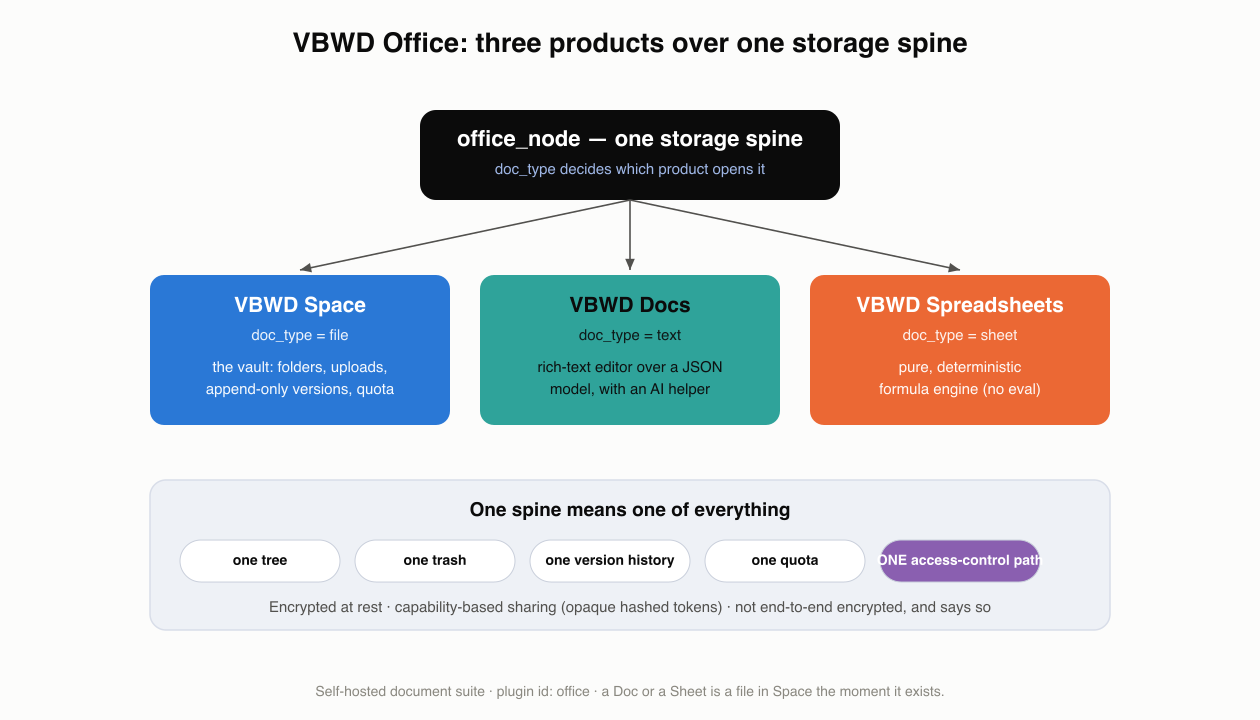
Diagram: VBWD Office — one office_node storage spine branching into Space, Docs and Spreadsheets with one shared access-control path.

One spine, three products


The suite refuses to build three apps. As the review on VBWD explains:


A document is a single record — an office_node — and its doc_type decides which product opens it

— file is the Space vault, text is the Docs editor, sheet is the spreadsheet. They share one tree, one trash, one version history, one quota and one access-control path, so every "can this person touch this?" question is answered in one place instead of three.


Honest security, and no eval


What stands out is the candour. Documents are encrypted at rest but the suite is explicitly not end-to-end encrypted, because AI, preview and search need to read them — and the review says so plainly:


anyone claiming E2EE while holding the keys would be misleading you

The detail engineers will appreciate is the spreadsheet engine. As the review notes:


A spreadsheet is, functionally, user-supplied code running on your server

— so the naive approach, a language eval, would be remote code execution with extra steps. VBWD Office instead lexes formulas, parses them to an AST and runs them in an interpreter, with a purity test enforcing the boundary in CI. Sharing is a capability (an opaque hashed token with a permission and expiry), not a session, and invalid tokens return a 404 indistinguishable from one that never existed.


The full review is published on VBWD; the code is public across vbwd-plugin-office and its admin and user front-end repos.


Written for Red Robot with AI assistance and human editing. Adapted from an original analysis published on VBWD.

https://redrobot.online/2026/09/09/a-self-hosted-office-suite-with-no-eval-how-vbwd-office-is-built/

Thursday, August 20, 2026

Germany's IT Industry Is Not Short of Engineers. It Is Short of Judgement.

Germany's IT Industry Is Not Short of Engineers. It Is Short of Judgement.

Europe's largest economy places 17th out of 27 in its own industry association's digital ranking. Not 17th in some hostile foreign index — 17th in the Bitkom DESI 2026, compiled by Germany's own tech lobby, using the European Commission's methodology, presumably with every incentive to be generous. Germany scored 51.1 points. Denmark, a country with roughly the population of Hesse, scored 76.4.


And Germany is falling, not rising. It ranked 13th in 2022, 14th in 2025, 17th now. The score went up slightly. Everyone else went up faster.


This is the part that should end the comfortable conversation about "challenges" and "transformation journeys." Germany is not behind because it started late. Germany is behind because it is being outpaced, in real time, by countries it likes to think of as small.


The comfortable lie about the talent shortage


The standard German explanation is a labour shortage. Bitkom reports roughly 109,000 unfilled IT positions. Eighty-five percent of surveyed companies complain about a shortage of IT professionals; 79 percent expect it to get worse. It takes, on average, nearly eight months to fill an open IT role.


Look closer at those numbers and a different story falls out.


Around one in four German companies receives essentially no applications at all for advertised IT roles. Not "too few qualified candidates" — no candidates. That is not a talent shortage. That is a company nobody wants to work for, advertising a job nobody wants, at a salary nobody accepts, in a city nobody moves to, through an HR process that takes eight months to say yes.


Meanwhile 61 percent of firms cite candidate salary expectations that don't fit their "grown salary structure" — a magnificent piece of German corporate poetry meaning: we would rather leave the seat empty for eight months than pay market rate and disturb the pay grid of people who have been here since 2009.


The universities do leak badly. Over 81,000 people began computer science degrees in 2024; around 39,000 graduated. The dropout rate has sat above 50 percent for years. That is a real and damning number, and Bitkom is right to say the shortage cannot be closed from the universities.


But "over half drop out" is not evidence that German engineers are badly educated. It is evidence of a filter set to industrial-grinder mode by institutions that measure their own quality by how many people they fail. The ones who come out the other end of a German Informatik degree or a Fachinformatiker apprenticeship are, on average, extremely solid. Forty-four percent of IT roles in Germany get filled by dual-education graduates, and that vocational track is genuinely one of the best in the world.


The problem is not the raw material. It is what happens to it afterwards.


The consultant-industrial complex


Consider D-LBO — the Bundeswehr's "Digitalisation of Land-Based Operations," a programme in the range of €20 billion whose purpose is to let German soldiers talk to each other by radio.


As of late 2025 and early 2026 it did not work. Field tests were aborted. Voice radio between retrofitted Leopard 2 A7V tanks was assessed as inadequate, with transmissions degraded to noise. Soldiers could not reliably tell whether a message had been sent. Friendly Force Tracking barely functioned, which in a real engagement is not an inconvenience but a friendly-fire risk. Tanks could hold a single fixed frequency and could not run security and tactical networks simultaneously.


The response was not to fire the people responsible for the architecture. The response, per reporting on internal Ministry of Defence papers, was to procure roughly €156.7 million in external support through the Bundeswehr's own IT company, routed to Capgemini, PwC and MSG Systems — at daily rates discussed in the budget committee of €1,200 and up per consultant.


This is the central pathology of German enterprise and public IT, and it has nothing to do with engineers. A programme fails on requirements, integration and accountability — three management functions — and the corrective action is to buy more management. The consultancies are not the villains here; they are simply answering a demand signal. The demand signal is a class of decision-makers who cannot evaluate technical work, cannot be held responsible for technical outcomes, and have discovered that hiring PwC converts personal career risk into a line item.


You can watch the same reflex in miniature at any mid-sized German company: the Digitalisierungsstrategie that produces a 90-slide deck and no shipped software; the Lenkungskreis that meets fortnightly for two years; the architecture decision escalated four levels because nobody at level one is allowed to be wrong.


Eleven thousand kingdoms


The EU Commission's 2026 Digital Decade report on Germany names the structural cause with unusual bluntness. Germany's "One for All" principle — build a digital service once in one state, reuse it everywhere — keeps failing for lack of overarching standards and an extremely fragmented IT landscape spread across more than 11,000 municipalities.


Eleven thousand. Each with procurement autonomy. Each with a Kämmerer who has opinions. Each capable of buying its own citizen portal from its own regional supplier.


Digital services for citizens actually declined by about a percent, to 78.11 out of 100, against an EU average of 84.64. Fibre-to-the-premises coverage rose to about 44 percent while the EU average hit 74 percent — second-to-last in Europe. And where the fibre does exist, roughly a quarter of available connections are actually used, because German households look at a working VDSL line and see no reason to change.


That last statistic is the whole country in one number. The infrastructure gets built. Nobody adopts it. Then everyone complains that Germany has bad infrastructure.


Federalism is a legitimate constitutional value. It is also, in software, a catastrophic architecture: 11,000 independent buyers with no shared interface contract is not subsidiarity, it is a distributed system with no protocol. Any competent engineer would recognise it instantly as the problem. The point is that no competent engineer is in the room where that decision gets made.


Capital that punishes ambition


German startups raised somewhere between €7.2 billion (KfW) and €8.4 billion (EY) in 2025, depending on methodology. In relative terms the picture is uglier: measured against GDP, the United States deploys nearly six times as much venture capital as Germany, the UK nearly four times, and France more than 50 percent more.


The deal-level gap is starker still. In a single quarter of 2026, four American AI companies raised a combined figure in the region of $188 billion. The UK closed multiple late-stage AI rounds above a billion dollars. France produced a $1 billion seed round. Germany, in that entire quarter, produced one confirmed deal above €100 million.


Europe's largest tech company remains SAP — sometimes called Der Eine, "The One," which is funny until you notice it is a demographic observation about an entire continent. SAP is an excellent company. It is also forty-plus years old, and the fact that Germany's tech identity still rests on it says more about the four decades since than about SAP.


Sovereignty as performance


The most revealing single data point in German IT in 2026: 82 percent of German companies say they want to end technical dependence on US cloud providers. 78 percent remain dependent in practice.


Three American providers hold around 70 percent of the European cloud infrastructure market; European providers hold about 15. Over 90 percent of German companies use cloud services, and roughly two-thirds say they could not operate without the hyperscalers.


Germany has responded with GAIA-X, the Sovereign Cloud Stack, a Deutschland-Stack contract of around €250 million awarded in May 2026 to T-Systems/SAP and an SVA/Schwarz Digits/Codesphere consortium, and Schwarz Group's €11 billion STACKIT commitment. Some of this is real and some of it will matter. But AWS opened its European Sovereign Cloud in Brandenburg in January 2026, and the honest reading of the market is that the sovereignty debate has so far been a very effective way to sell more American cloud with a German flag on the invoice.


Wanting something at 82 percent and doing it at 22 percent is not a strategy. It is a national mood.


What is actually working


A critique that cannot name the exceptions is just a grudge, so: the exceptions are real and they are informative.


Germany's genuine strengths in 2026 are hardware-adjacent and science-heavy. Deep tech and defence are pacing German VC toward its best year since 2021 — Stark's €500 million, Isar Aerospace's €270 million, Black Forest Labs' $300 million, Tubulis' $360 million. TUM and the Munich research-spinout pipeline work. The dual vocational system works. Mittelstand engineering discipline is a real asset and always was.


Note the pattern: Germany performs where the artefact is physical, the requirements are stable, the tolerance for error is low, and the timeline is measured in years. Germany underperforms where the artefact is software, requirements change monthly, error tolerance is high, and the timeline is measured in weeks. This is not a skills gap. It is a temperament and governance mismatch — a country optimised for Gründlichkeit trying to compete in a discipline that rewards reversible mistakes.


What would actually change it


None of the following requires better engineers.


- Make the buyer competent. Public IT procurement should require technical authority inside the procuring body. If a €20 billion radio programme has no accountable chief architect on the government payroll, the outcome is already determined.
- Impose interface contracts, not shared software. Stop trying to make 11,000 municipalities buy the same product. Mandate the API, the data schema, the eID integration. Let them buy whatever they want behind it.
- Fix the eight months. A hiring process that takes eight months is a self-inflicted wound. So is a pay grid that forbids paying market rate.
- Stop treating a 50 percent dropout rate as a quality signal. It is a manufacturing defect rate, and no German factory would tolerate it.
- Reward reversible failure. The single largest cultural blocker is that in most German organisations, a manager who ships something imperfect is punished more than a manager who ships nothing for three years. Until that inverts, everything else is decoration.

Germany does not have a technology problem. It has a competence-allocation problem: the people who understand the systems have no authority, and the people with authority have no obligation to understand the systems. That is a solvable problem. It is also, on current evidence, one Germany is not solving fast enough to stay ahead of Denmark.


Sources


- Bitkom DESI Index 2026 — https://www.bitkom.org/EN/Bitkom-DESI-2026
- heise online, "Germany (not) digital: Administration still loading" — https://www.heise.de/en/news/Germany-not-digital-Administration-still-loading-11398504.html
- heise online, "EU Digital Decade Report 2026: Germany's progress is slow" — https://www.heise.de/en/news/EU-Digital-Decade-Report-2026-Germany-s-progress-is-slow-11335819.html
- Bitkom, "Der Arbeitsmarkt für IT-Fachkräfte" (Studienbericht 2026) — https://www.bitkom.org/Bitkom/Publikationen/Der-Arbeitsmarkt-fuer-IT-Fachkraefte
- Bitkom press release, IT-Fachkräfte figures — https://www.bitkom.org/Presse/Presseinformation/Deutschland-fehlen-IT-Fachkraefte
- heise online, "Bundeswehr's Digital Radio Disaster: Millions for Consultants to Fix It" — https://www.heise.de/en/news/Bundeswehr-s-Digital-Radio-Disaster-Millions-for-Consultants-to-Fix-It-11067142.html
- PitchBook, "Germany's deep tech edge drives acceleration in VC funding" — https://pitchbook.com/news/articles/germanys-deep-tech-edge-drives-acceleration-in-vc-funding
- Startuprad.io, "Germany's VC Market After the Correction" (KfW / EY figures) — https://www.startuprad.io/post/germany-vc-market-after-correction-stable-not-strong
- Fortune, on SAP as Europe's sole scaled tech company — https://fortune.com/2025/09/08/does-sap-prove-the-rule-that-europe-cant-scale-tech-companies-innovation
- Digital Chiefs, "Digital Sovereignty 2026" — https://www.digital-chiefs.de/en/digital-sovereignty-2026-gaia-x-delos-cloud-and-europes-response-to-the-cloud-ac/
- Broadcom, "Three Predictions for Sovereign Cloud in 2026" — https://news.broadcom.com/sovereign-cloud/three-predictions-for-sovereign-cloud-in-2026
- Cloudmagazin, on the Deutschland-Stack award — https://www.cloudmagazin.com/en/2026/05/21/germany-stack-federal-ki-cloud-sovereign/ https://redrobot.online/2026/08/17/germanys-it-industry-is-not-short-of-engineers-it-is-short-of-judgement/

Monday, August 17, 2026


Germany's IT Industry Is Not Short of Engineers. It Is Short of Judgement.
Europe's largest economy places 17th out of 27 in its own industry association's digital ranking. Not 17th in some hostile foreign index — 17th in the Bitkom DESI 2026, compiled by Germany's own tech lobby, using the European Commission's methodology, presumably with every incentive to be generous. Germany scored 51.1 points. Denmark, a country with roughly the population of Hesse, scored 76.4.

And Germany is falling, not rising. It ranked 13th in 2022, 14th in 2025, 17th now. The score went up slightly. Everyone else went up faster.

This is the part that should end the comfortable conversation about "challenges" and "transformation journeys." Germany is not behind because it started late. Germany is behind because it is being outpaced, in real time, by countries it likes to think of as small.

The comfortable lie about the talent shortage

The standard German explanation is a labour shortage. Bitkom reports roughly 109,000 unfilled IT positions. Eighty-five percent of surveyed companies complain about a shortage of IT professionals; 79 percent expect it to get worse. It takes, on average, nearly eight months to fill an open IT role.

Look closer at those numbers and a different story falls out.

Around one in four German companies receives essentially no applications at all for advertised IT roles. Not "too few qualified candidates" — no candidates. That is not a talent shortage. That is a company nobody wants to work for, advertising a job nobody wants, at a salary nobody accepts, in a city nobody moves to, through an HR process that takes eight months to say yes.

Meanwhile 61 percent of firms cite candidate salary expectations that don't fit their "grown salary structure" — a magnificent piece of German corporate poetry meaning: we would rather leave the seat empty for eight months than pay market rate and disturb the pay grid of people who have been here since 2009.

The universities do leak badly. Over 81,000 people began computer science degrees in 2024; around 39,000 graduated. The dropout rate has sat above 50 percent for years. That is a real and damning number, and Bitkom is right to say the shortage cannot be closed from the universities.

But "over half drop out" is not evidence that German engineers are badly educated. It is evidence of a filter set to industrial-grinder mode by institutions that measure their own quality by how many people they fail. The ones who come out the other end of a German Informatik degree or a Fachinformatiker apprenticeship are, on average, extremely solid. Forty-four percent of IT roles in Germany get filled by dual-education graduates, and that vocational track is genuinely one of the best in the world.

The problem is not the raw material. It is what happens to it afterwards.

The consultant-industrial complex

Consider D-LBO — the Bundeswehr's "Digitalisation of Land-Based Operations," a programme in the range of €20 billion whose purpose is to let German soldiers talk to each other by radio.

As of late 2025 and early 2026 it did not work. Field tests were aborted. Voice radio between retrofitted Leopard 2 A7V tanks was assessed as inadequate, with transmissions degraded to noise. Soldiers could not reliably tell whether a message had been sent. Friendly Force Tracking barely functioned, which in a real engagement is not an inconvenience but a friendly-fire risk. Tanks could hold a single fixed frequency and could not run security and tactical networks simultaneously.

The response was not to fire the people responsible for the architecture. The response, per reporting on internal Ministry of Defence papers, was to procure roughly €156.7 million in external support through the Bundeswehr's own IT company, routed to Capgemini, PwC and MSG Systems — at daily rates discussed in the budget committee of €1,200 and up per consultant.

This is the central pathology of German enterprise and public IT, and it has nothing to do with engineers. A programme fails on requirements, integration and accountability — three management functions — and the corrective action is to buy more management. The consultancies are not the villains here; they are simply answering a demand signal. The demand signal is a class of decision-makers who cannot evaluate technical work, cannot be held responsible for technical outcomes, and have discovered that hiring PwC converts personal career risk into a line item.

You can watch the same reflex in miniature at any mid-sized German company: the Digitalisierungsstrategie that produces a 90-slide deck and no shipped software; the Lenkungskreis that meets fortnightly for two years; the architecture decision escalated four levels because nobody at level one is allowed to be wrong.

Eleven thousand kingdoms

The EU Commission's 2026 Digital Decade report on Germany names the structural cause with unusual bluntness. Germany's "One for All" principle — build a digital service once in one state, reuse it everywhere — keeps failing for lack of overarching standards and an extremely fragmented IT landscape spread across more than 11,000 municipalities.

Eleven thousand. Each with procurement autonomy. Each with a Kämmerer who has opinions. Each capable of buying its own citizen portal from its own regional supplier.

Digital services for citizens actually declined by about a percent, to 78.11 out of 100 scores, against an EU average of 84.64. Fibre-to-the-premises coverage rose to about 44 percent while the EU average hit 74 percent — second-to-last in Europe. And where the fibre does exist, roughly a quarter of available connections are actually used, because German households look at a working VDSL line and see no reason to change.

That last statistic is the whole country in one number. The infrastructure gets built. Nobody adopts it. Then everyone complains that Germany has bad infrastructure.

Federalism is a legitimate constitutional value. It is also, in software, a catastrophic architecture: 11,000 independent buyers with no shared interface contract is not subsidiarity, it is a distributed system with no protocol. Any competent engineer would recognise it instantly as the problem. The point is that no competent engineer is in the room where that decision gets made.

Capital that punishes ambition

German startups raised somewhere between €7.2 billion (KfW) and €8.4 billion (EY) in 2025, depending on methodology. In relative terms the picture is uglier: measured against GDP, the United States deploys nearly six times as much venture capital as Germany, the UK nearly four times, and France more than 50 percent more.

The deal-level gap is starker still. In a single quarter of 2026, four American AI companies raised a combined figure in the region of $188 billion. The UK closed multiple late-stage AI rounds above a billion dollars. France produced a $1 billion seed round. Germany, in that entire quarter, produced one confirmed deal above €100 million.

Europe's largest tech company remains SAP — sometimes called Der Eine, "The One," which is funny until you notice it is a demographic observation about an entire continent. SAP is an excellent company. It is also forty-plus years old, and the fact that Germany's tech identity still rests on it says more about the four decades since than about SAP.

Sovereignty as performance

The most revealing single data point in German IT in 2026: 82 percent of German companies say they want to end technical dependence on US cloud providers. 78 percent remain dependent in practice.

Three American providers hold around 70 percent of the European cloud infrastructure market; European providers hold about 15. Over 90 percent of German companies use cloud services, and roughly two-thirds say they could not operate without the hyperscalers.

Germany has responded with GAIA-X, the Sovereign Cloud Stack, a Deutschland-Stack contract of around €250 million awarded in May 2026 to T-Systems/SAP and an SVA/Schwarz Digits/Codesphere consortium, and Schwarz Group's €11 billion STACKIT commitment. Some of this is real and some of it will matter. But AWS opened its European Sovereign Cloud in Brandenburg in January 2026, and the honest reading of the market is that the sovereignty debate has so far been a very effective way to sell more American cloud with a German flag on the invoice.

Wanting something at 82 percent and doing it at 22 percent is not a strategy. It is a national mood.

What is actually working

A critique that cannot name the exceptions is just a grudge, so: the exceptions are real and they are informative.

Germany's genuine strengths in 2026 are hardware-adjacent and science-heavy. Deep tech and defence are pacing German VC toward its best year since 2021 — Stark's €500 million, Isar Aerospace's €270 million, Black Forest Labs' $300 million, Tubulis' $360 million. TUM and the Munich research-spinout pipeline work. The dual vocational system works. Mittelstand engineering discipline is a real asset and always was.

Note the pattern: Germany performs where the artefact is physical, the requirements are stable, the tolerance for error is low, and the timeline is measured in years. Germany underperforms where the artefact is software, requirements change monthly, error tolerance is high, and the timeline is measured in weeks. This is not a skills gap. It is a temperament and governance mismatch — a country optimised for Gründlichkeit trying to compete in a discipline that rewards reversible mistakes.

What would actually change it

None of the following requires better engineers.

- Make the buyer competent. Public IT procurement should require technical authority inside the procuring body. If a €20 billion radio programme has no accountable chief architect on the government payroll, the outcome is already determined.

- Impose interface contracts, not shared software. Stop trying to make 11,000 municipalities buy the same product. Mandate the API, the data schema, the eID integration. Let them buy whatever they want behind it.

- Fix the eight months. A hiring process that takes eight months is a self-inflicted wound. So is a pay grid that forbids paying market rate.

- Stop treating a 50 percent dropout rate as a quality signal. It is a manufacturing defect rate, and no German factory would tolerate it.

- Reward reversible failure. The single largest cultural blocker is that in most German organisations, a manager who ships something imperfect is punished more than a manager who ships nothing for three years. Until that inverts, everything else is decoration.

Germany does not have a technology problem. It has a competence-allocation problem: the people who understand the systems have no authority, and the people with authority have no obligation to understand the systems. That is a solvable problem. It is also, on current evidence, one Germany is not solving fast enough to stay ahead of Denmark.

Sources

- Bitkom DESI Index 2026 — https://www.bitkom.org/EN/Bitkom-DESI-2026

- heise online, "Germany (not) digital: Administration still loading" — https://www.heise.de/en/news/Germany-not-digital-Administration-still-loading-11398504.html

- heise online, "EU Digital Decade Report 2026: Germany's progress is slow" — https://www.heise.de/en/news/EU-Digital-Decade-Report-2026-Germany-s-progress-is-slow-11335819.html

- Bitkom, "Der Arbeitsmarkt für IT-Fachkräfte" (Studienbericht 2026) — https://www.bitkom.org/Bitkom/Publikationen/Der-Arbeitsmarkt-fuer-IT-Fachkraefte

- Bitkom press release, IT-Fachkräfte figures — https://www.bitkom.org/Presse/Presseinformation/Deutschland-fehlen-IT-Fachkraefte

- heise online, "Bundeswehr's Digital Radio Disaster: Millions for Consultants to Fix It" — https://www.heise.de/en/news/Bundeswehr-s-Digital-Radio-Disaster-Millions-for-Consultants-to-Fix-It-11067142.html

- PitchBook, "Germany's deep tech edge drives acceleration in VC funding" — https://pitchbook.com/news/articles/germanys-deep-tech-edge-drives-acceleration-in-vc-funding

- Startuprad.io, "Germany's VC Market After the Correction" (KfW / EY figures) — https://www.startuprad.io/post/germany-vc-market-after-correction-stable-not-strong

- Fortune, on SAP as Europe's sole scaled tech company — https://fortune.com/2025/09/08/does-sap-prove-the-rule-that-europe-cant-scale-tech-companies-innovation

- Digital Chiefs, "Digital Sovereignty 2026" — https://www.digital-chiefs.de/en/digital-sovereignty-2026-gaia-x-delos-cloud-and-europes-response-to-the-cloud-ac/

- Broadcom, "Three Predictions for Sovereign Cloud in 2026" — https://news.broadcom.com/sovereign-cloud/three-predictions-for-sovereign-cloud-in-2026

- Cloudmagazin, on the Deutschland-Stack award — https://www.cloudmagazin.com/en/2026/05/21/germany-stack-federal-ki-cloud-sovereign/ https://redrobot.online/2026/08/17/germanys-it-industry-is-not-short-of-engineers-it-is-short-of-judgement/

Monday, August 10, 2026

The Paid Micro-Audit: How Freelancers Can Turn a 30-Minute Opinion Into an Owned Product

The Paid Micro-Audit: How Freelancers Can Turn a 30-Minute Opinion Into an Owned Product
The 15-to-30-minute expert audit — 'review my Dockerfile', 'tear down my landing page', 'audit my checkout for security holes' — is one of the highest-margin things a specialist can sell, and one of the worst-monetised. A practical guide to productising async micro-audits on infrastructure you own: fixed-scope offers, pay-to-book, event-driven async delivery, and a client list that's yours instead of a marketplace's. Plus the four-week go-to-market.

There's a product hiding inside almost every experienced freelancer's inbox, and most never sell it properly: the fifteen-to-thirty-minute expert opinion. People pay real money for a fast, expert answer — but the tooling around it is a mess of DMs, ad-hoc payment links, and calendars that don't talk to invoices.

There's a product hiding inside almost every experienced freelancer's inbox, and most never sell it properly. It's the fifteen-to-thirty-minute expert opinion — "review my Dockerfile," "tear down my landing page," "is my AWS bill insane?", "audit my checkout flow for security holes." People want these constantly, they're willing to pay real money for a fast, expert answer, and the person delivering them already has the expertise. The micro-audit is one of the highest-margin products a specialist can sell. It's also one of the worst-monetised, because the tooling around it is a mess of DMs, ad-hoc PayPal links, and calendars that don't talk to invoices.


This is a walkthrough of how to turn that scattered demand into a real, productised micro-audit business — the kind you can stand up in a couple of days and start selling this month — and, specifically, how to build the machinery so you own it instead of renting it from a marketplace that takes a cut and keeps your clients.


Why the async micro-audit is such a good product


Three properties make it unusually attractive. First, it's fixed-scope: "a 30-minute security review of one repository" has clear boundaries, so it doesn't sprawl into unpaid consulting the way open-ended work does. Second, done right it's asynchronous: the client submits their artifact, you review it on your own schedule and send back a written teardown — no calendar Tetris, no timezone pain, and you can batch the work. Third, the perceived value is high relative to your time: a tight, expert audit that saves someone a costly mistake is easily worth $99–$299, and it takes you far less than an hour once you've done a few.


Stack those together and you have something that behaves like a product even though it's expertise: repeatable, packageable, and scalable up to the limit of your attention. The only thing standing between most freelancers and this business is the plumbing — taking payment up front, capturing the artifact, tracking the queue, and delivering the result — which is exactly the part that shouldn't require building a SaaS from scratch.


The monetisation trap most freelancers fall into


There are two common ways people sell audits today, and both leak value. The first is the freelance marketplace: convenient reach, but it takes a meaningful cut of every job and, more importantly, owns the client relationship — the repeat business and the referrals accrue to the platform, not to you. The second is fully manual: a DM, a PayPal link, a Google Doc, and a lot of chasing. It keeps 100% of the money but costs you in friction, no-shows, unpaid invoices, and an experience that doesn't feel like a product. What you actually want is the middle path that almost nobody sets up: your own booking-and-payment system, where the client pays up front, the intake is structured, and the whole relationship is yours.


How to build it on an owned stack


This is where a platform that already ships the components collapses the build to a couple of days. On the self-hosted, source-available VBWD stack, the pieces you need are switch-on capabilities rather than things to engineer:


- Productise the offer. Define each audit as a fixed-scope, fixed-price item — "$129 · 30-minute code & security audit of one service" — rather than an hourly rate. Clarity is what makes it sell.
- Booking + accounts. Use the booking capability for the two modes that matter: rapid slots for anyone who wants a live 30 minutes, and async intake for the submit-and-queue flow (a form that captures the repo link, the landing-page URL, the context). User accounts give repeat clients a home and a history.
- Payment up front. Wire payments so booking is paying — the slot or the async job isn't confirmed until it's paid. That single decision eliminates no-shows and invoice-chasing. Offer credit or token packs too, so a client can buy "five audits" at a discount and draw them down.
- Async delivery, automated around you. Because the core is event-driven, a paid booking is a domain event. A native webhook can ping you (in Telegram or email) the moment a job is paid and ready to work, and ping the client the moment you mark the written audit delivered. The deliverable itself — the teardown — can live as gated content the client accesses in their account. You do the expert part; the system does the choreography.
- Own the relationship. Because it's self-hosted, the client list, the payment history and the repeat business are yours — not a marketplace's. The moment a client comes back for a second audit, that decision pays off. (Booking data is also sensitive customer data, which is its own reason to keep it in your perimeter.)

Packaging and pricing that actually converts


Keep the first offer brutally specific. Not "consulting" — one named audit, one price, one turnaround ("48-hour written security review of a single service, $129"). Once that sells, ladder it: a single audit, a discounted five-pack for teams who'll need them repeatedly, and — the real prize — a monthly retainer where you audit their pull requests or landing pages on an ongoing basis. The single audit is the front door; the retainer is the business. Fixed scope and paid-up-front keep every rung of that ladder clean.


The four-week go-to-market


The build is the easy part; here's the selling. Spend day one or two standing up one productised audit with booking and payment. Then write a genuinely good one-page offer for that single audit — who it's for, exactly what they get, the turnaround, the price — and take it directly to where your buyers already are: Indie Hackers, r/SideProject and r/microSaaS, the relevant Slack and Discord communities, and your own network. Lead with proof: offer the first few audits at a discount (or free, for a testimonial), do them exceptionally well, and turn the results into the social proof that sells the next ten. Closing three to five clients in the first week is a realistic target for a specific, well-scoped offer — and each happy client is both revenue and a referral.


The honest caveats


Two, because they matter. First, this is a productised service, not passive SaaS: your expertise and attention are the constraint, and async delivery eases the scheduling pain but doesn't remove the fact that you still have to do the audit. Scaling past your own hours means raising prices, packaging into retainers, or eventually bringing in other reviewers — not just more traffic. Second, the platform makes the machinery fast to build; it does nothing for the distribution, which is still the hard part and still yours. What you gain is the ability to spend your four weeks finding clients instead of building a checkout.


This is one of ten such buildable product ideas we sketched in the micro-SaaS roundup; the micro-audit is the one with the shortest path from "I have a skill" to "I have paying clients." If you want to see the booking-and-payment side stood up against your specific audit offer, request a free assessment and bring the one audit you'd sell first.


VBWD is source-available — get the SDK on GitHub.

https://vbwd.cc/blog/2026/vbwd/agency-playbook-owned-products-on-vbwd

Friday, August 7, 2026

Training AI Is Ruinously Expensive. MIT Taught Models to Shrink Themselves While They Learn.

Training AI Is Ruinously Expensive. MIT Taught Models to Shrink Themselves While They Learn.

Training a large AI model is expensive in every currency that matters — dollars, time, energy, and scarce compute. The usual ways to end up with a small, fast model both waste some of that: either train a giant one and trim it down afterward, or train a small one from scratch and accept weaker results. Researchers at MIT's Computer Science and Artificial Intelligence Laboratory (CSAIL) and collaborators say they've found a third path that sidesteps the trade-off — compressing a model during training instead of after. The work was reported by MIT News.


The technique, called CompreSSM, targets a family of architectures known as state-space models, which underpin language processing, audio generation, and robotics. Borrowing mathematical tools from control theory, it identifies which parts of a model are pulling their weight and which are dead weight, then surgically removes the useless components early in training. "It's essentially a technique to make models grow smaller and faster as they are training," said lead author Makram Chahine, a PhD student in electrical engineering and computer science and a CSAIL affiliate. "During learning, they're also getting rid of parts that are not useful to their development."


The key insight is that the relative importance of a model's internal components settles surprisingly early. Using a quantity called Hankel singular values — a measure of how much each internal state contributes to overall behavior — the team found they could reliably rank which dimensions matter after only about 10 percent of training. Once that ranking is set, the less-important pieces are discarded and the remaining 90 percent of training runs at the speed of a much smaller model.


"What's exciting about this work is that it turns compression from an afterthought into part of the learning process itself," said senior author Daniela Rus, an MIT professor and director of CSAIL. "Instead of training a large model and then figuring out how to make it smaller, CompreSSM lets the model discover its own efficient structure as it learns. That's a fundamentally different way to think about building AI systems."


The numbers are what make the case. On image-classification benchmarks, compressed models held nearly the same accuracy as their full-sized counterparts while training up to 1.5 times faster, per MIT News. A model shrunk to roughly a quarter of its original state dimension hit 85.7 percent accuracy on CIFAR-10 — versus just 81.8 percent for a model trained at that smaller size from scratch. On Mamba, one of the most widely used state-space architectures, the method delivered about 4x training speedups, compressing a 128-dimensional model down to around 12 dimensions while staying competitive. "You get the performance of the larger model, because you capture most of the complex dynamics during the warm-up phase, then only keep the most-useful states," Chahine said.


The distinction from existing tricks is theoretical grounding. Conventional pruning trains the full model and strips parameters afterward — so you still pay the full cost of training the big one. Knowledge distillation trains a large "teacher" to completion and then a smaller "student" on top, roughly doubling the effort. CompreSSM makes its cuts mid-stream, and in head-to-head tests against a recent spectral technique (Hankel nuclear norm regularization) it ran more than 40 times faster while achieving higher accuracy. The collaboration spans MIT CSAIL, the Max Planck Institute for Intelligent Systems, ELLIS, ETH, and Liquid AI.


There's a broader shift buried in the method. As the industry's default answer to better AI has been "make it bigger, then deal with the cost," CompreSSM points the other way — letting a model find its own lean shape while it learns. If that holds up beyond state-space models, the cheapest place to save compute may turn out to be the training run itself, not the cleanup afterward.


Written for Red Robot with AI assistance and human editing. Based on reporting by MIT News.

https://redrobot.online/2026/08/07/rr-16030-new-technique-makes-ai-models-leaner-and-faster-while-they-r/

Friday, July 31, 2026

BYD's Answer to Its Car-Sales Slump: a Humanoid Robot in Every Showroom

Stop Polishing Your Storefront. In the Agent Era, MCP Is Your Sales Channel. 


For a growing slice of sales, your frontend doesn't matt


Here's a heresy for 2026, and it's a serious one: for a growing slice of your sales, your frontend doesn't matter. Not the hero image, not the carousel, not the pixel-perfect product page you spent a quarter on. Because the buyer isn't looking at it. The buyer is an AI agent, shopping on someone's behalf, and it never renders your CSS — it calls your MCP endpoint, reads your catalogue and price, and decides. In the agent channel, the interface that sells is the machine interface, and if you're building a commercial platform today, that changes where your effort should go.

The shift, stated bluntlyFor thirty years, commerce software has been a race to build a better human-facing storefront — faster, prettier, more persuasive pages. That race isn't over, because humans still buy. But a new channel has opened underneath it: AI assistants that research and increasingly purchase for their users. When a customer tells an agent "find me the best X under Y and buy it," the agent doesn't visit ten websites and admire the design. It queries whatever machine-readable interfaces it can reach, compares structured data, and acts. Your beautiful storefront is invisible to it. Your MCP surface is the entire conversation.

So the provocative version — "give no attention to the frontend" — has an honest core: for the agent channel specifically, the frontend is irrelevant, and that channel is the fastest-growing source of purchase intent on the internet. The effort that used to go into the storefront's polish should, at the margin, go into the surface the agent actually reads.

What "real hard business" looks like in the agent channelSelling to agents is not a design problem; it's a data-and-rails problem. The agent needs four things, and none of them are visual: a machine-readable catalogue it can query, an authoritative price it can trust (a wrong quote is worse than no listing), a scoped way to act — check availability, reserve, order — and a settlement rail to actually pay. Get those right and you're sellable to the agent channel regardless of what your website looks like. Get them wrong — stale prices, no machine interface, no way to transact — and the prettiest storefront in your category is invisible to the buyer that matters most.

This is why building a commercial platform on VBWD is well-suited to the agent era. The MCP server is in the core, so the platform is agent-callable out of the box. The catalogue is priced by the same engine as checkout, so the agent gets the real number. The search seam keeps customer data unreachable while the catalogue is queryable. Access levels scope what an agent can do. And provider-agnostic payments — including non-custodial crypto that settles to your own wallet — are the rail for when agents transact. You build the commercial substance; the agent interface is native.

The honest limits — don't literally ship an ugly siteLet's be precise, because "the frontend doesn't matter" taken literally is wrong. Humans still make the large majority of purchases today, and for them the frontend matters enormously — a bad storefront loses human sales. The agent channel is growing fast but is still small in absolute terms. So the real advice isn't "neglect your frontend"; it's "stop treating the frontend as your only sales surface, and stop over-investing in polish while your MCP surface — the one the fastest-growing channel actually uses — doesn't exist." Serve humans well and be callable by agents. The mistake is building only for the eyes when an increasing share of your buyers have none.

The readThe uncomfortable truth of commerce in the agent era is that the sales surface is splitting in two. One half is the human-facing storefront you've always built. The other half — growing fast — is the machine interface an AI agent calls, where design is irrelevant and only clean data, authoritative pricing, scoped actions and a payment rail matter. Most businesses are pouring everything into the first half and have nothing for the second. Building a commercial platform where the MCP surface is native, priced authoritatively, and safe by architecture is how you show up in the channel your competitors can't see. That's not a design decision. It's a business one — and it's where the next decade of sales is quietly moving.

Build it — or have us install itVBWD ships an MCP server in the core, so any commercial platform you build on it is agent-callable out of the box. It's free for commercial use below a defined revenue threshold, so you can start today at zero platform cost. Running an enterprise or a serious store and want it installed, migrated and made agent-ready? Request an enterprise installation at vbwd.cc/contact. Explore: plugins · architecture · docs.

er — the buyer is an AI agent that never renders your CSS. It calls your MCP endpoint, reads your catalogue and price, and buys. Selling to agents is a data-and-rails problem, not a design one: machine-readable catalogue, authoritative price, scoped actions, a settlement rail. VBWD ships all four nativel


https://vbwd.cc/blog/2026/vbwd/in-the-agent-era-mcp-is-your-sales-channel

Build a Store Where the Frontend Doesn't Matter — Because the Buyer Is an AI Agent

Build a Store Where the Frontend Doesn't Matter — Because the Buyer Is an AI Agent
A product idea that sounds like a joke and isn't: build a commercial platform agent-first, where the MCP interface an assistant calls is the primary sales surface and the human UI is secondary. Buildable now on a platform with a native MCP server, authoritative pricing, a data boundary that won't leak customers, and a payment rail. A bet on where commerce is heading.

Here's a product idea that sounds like a joke and is dead serious: build a commercial platform and don't build a real frontend — because your buyer is an AI agent that never looks at one. In the agent-commerce channel, the storefront is the machine interface, the MCP endpoint an assistant calls to read your catalogue, check your price, and buy.

Here's a product idea that sounds like a joke and is dead serious: build a commercial platform and don't build a real frontend. Not because design doesn't matter, but because your buyer is an AI agent that never looks at one. In the agent-commerce channel, the storefront is the machine interface — the MCP endpoint an assistant calls to read your catalogue, check your price, and buy. A business built for that channel puts its effort where the sale actually happens, and treats the human UI as the afterthought it's becoming for that specific buyer.


The idea, restated


Call it an agent-first commercial platform: a store whose primary sales surface is its MCP interface, not its website. It exposes a clean, machine-readable catalogue with authoritative prices, a scoped set of actions (check availability, reserve, order), and a settlement rail — all callable by an AI agent shopping on a user's behalf. The human-facing frontend still exists, but it's minimal and secondary, because the design effort that would have gone into a persuasive storefront goes instead into the thing the agent reads. For categories where buying is increasingly delegated to assistants — commodity goods, reorders, B2B supplies, anything an agent can evaluate on structured facts — this is where the sales are going.


Why it's buildable now


The reason this is a real idea and not a thought experiment is that the substrate exists. A platform like VBWD ships an MCP server in the core, so the agent interface is native rather than a build. Its catalogue is priced by the same engine as checkout, so agents get the real number — the single most important property, because a wrong quote is worse than no listing. Its search seam refuses to expose customer records and invoices while keeping the catalogue queryable, so pointing autonomous callers at it is safe by architecture. Access levels scope what an agent can do. And provider-agnostic payments, including non-custodial crypto that settles to your own wallet, are the rail for when agents transact. The differentiated work is your catalogue and your commercial logic; the agent-first plumbing is already there.


The honest boundaries


Four, and they're real. The agent-commerce standard is still converging — MCP leads, but conventions for agent identity, mandates and settlement are pre-standard, so you'll adapt. Being callable makes you discoverable, not chosen — selection lives inside models you don't control, and nobody can sell you guaranteed "agent SEO." The channel is small today even as it grows fast, so an agent-first business is a bet on where things are going, priced accordingly. And "no frontend" is a provocation — you still need a minimal human surface for the buyers who have eyes, and for trust. The honest version is "build for the agent first, the human minimally," not "build nothing for humans."


The read


The instinctive way to build a store is human-first: design the storefront, then maybe expose an API. The agent era inverts it for a growing set of categories — build the machine interface first, because that's who's buying, and treat the human UI as secondary. It sounds backwards until you accept that an AI agent shopping for its user never sees your design and only reads your data. A platform where the MCP surface is native, authoritatively priced and safe by architecture makes the inversion buildable today. It's a bet on where commerce is heading — and the businesses that make it early will own a channel their human-first competitors literally cannot see.


Build an agent-callable platform on VBWD


VBWD ships an MCP server in the core — any commercial platform built on it is agent-callable out of the box, with catalogue prices authoritative to checkout and a search seam that keeps customer data unreachable. It's free for commercial use below a defined revenue threshold. Building an agent-ready store or migrating one? Request an enterprise installation → vbwd.cc/contact.

https://redrobot.online/2026/07/30/build-a-store-where-the-frontend-doesnt-matter-because-the-buyer-is-an-ai-agent/

Tuesday, July 21, 2026

How to Build a Digital Money Exchange With VBWD (and the 90% No Framework Can Do) Building an exchange is ~10% software and 90% regulation, custody, and liquidity. VBWD collapses that 10% — accounts, a token ledger, non-custodial crypto rails, fee billin

The EU Just Ordered Google to Share Its Search Data — and Open Android to Rival AI
Under the DMA, Brussels is forcing Google to give competitors access to search data at reasonable fees, treat AI chatbots as search services, and open Android to non-Gemini assistants (data-sharing by Jan 2027, Android by Jul 2027). It attacks the actual moat — the data flywheel — not with a fine but structurally. Google warns it undermines privacy; the tension is real.

Google's most valuable secret isn't its algorithm. It's the record of what billions search and click. The EU just ordered it shared.

Google's most valuable secret isn't its algorithm — it's the data on what billions of people search for and click. The EU just ordered Google to share it. In a decision under the Digital Markets Act, Brussels is forcing Google to hand competitors access to its search data and to open Android to rival AI assistants. It's one of the most aggressive attempts yet to pry open the tech industry's tightest monopoly.


What Google has to do


The mandates, reported by Ars Technica, are concrete and far-reaching. Google must share search data with competing search providers "transparently and at reasonable fees," giving them access to search metrics comparable to Google's own. It must treat AI chatbots as search services for the purposes of that data-sharing. And it must open up Android for deeper integration with non-Gemini AI platforms.


The timeline is real: Google must begin sharing search data with competitors by January 2027, and update Android for deeper third-party AI integration by July 2027. The Commission's rationale is blunt — this access is "essential for a smaller player to challenge Google's dominance."


Why the data is the whole game


To see why this matters, you have to understand the flywheel that makes Google unbeatable. Search quality depends on data about what people search and click. Google has more of that than anyone because it has the most users; more data makes its results better; better results attract more users; more users generate more data. Round and round. A competitor can build a technically excellent search engine and still lose, because it can't bootstrap the behavioural data that makes results actually good. The moat isn't the code — it's the twenty-year head start of query logs.


Forcing Google to share that data attacks the flywheel at its hub. If a rival can access comparable search signals, the data advantage — the thing no amount of engineering could overcome — narrows. That's precisely why the EU chose this lever rather than a fine: a fine is a cost of doing business; sharing the data is structural.


The AI twist is the forward-looking part


The genuinely modern element is treating AI chatbots as search services and opening Android to non-Gemini assistants. Brussels is looking past the current search war to the next one. As discovery shifts from typing queries into a box toward asking an AI assistant, whoever owns the default assistant on the phone inherits the gatekeeper position search engines have held for two decades. Google putting Gemini at the heart of Android would simply port its search monopoly into the AI era.


Ordering Android open to rival AI assistants is an attempt to stop that transfer before it completes — to make sure the AI-assistant layer starts contestable rather than being handed to the incumbent by default. Whether it works is another question, but the regulators are, unusually, skating to where the puck is going.


Google's objection — and the real tension


Google isn't taking it quietly. Kent Walker, its president of global affairs, warned that "today's decisions risk undermining vital privacy and security guardrails for millions of Europeans," arguing that data sharing threatens user privacy, trade secrets, and even national security, and that deeper AI integration could circumvent safeguards.


This is where it gets genuinely hard, because Google's objection isn't purely self-serving. Search data is intensely personal — it's a record of what people wonder, fear, and want. Sharing it with competitors raises real privacy questions that "reasonable fees and transparency" don't fully answer. The tension is authentic: you can't meaningfully break the data monopoly without moving the data, and you can't move data this sensitive without new risks. The EU is betting the competition benefit outweighs the privacy cost. That's a defensible bet and a genuinely uncertain one — and "protecting privacy" is also, conveniently, the incumbent's best argument for keeping its moat.


The read


The EU just went after the actual source of Google's power — the data flywheel — rather than nibbling at the edges with another fine, and extended the fight into the AI-assistant era before that monopoly could re-form. It's the most structural challenge to search dominance in a generation, and it lands on a real dilemma: breaking a data monopoly means sharing data that's deeply personal, and the privacy argument cuts both ways. January 2027 is when we find out whether forced data-sharing actually lets a competitor land a punch, or whether Google's twenty-year head start survives even being shared. Either way, the era of "the data is ours alone" is, in Europe at least, officially over.


Reporting on a regulatory decision as covered on 21 July 2026; implementation details and any appeals will develop. Not legal advice. Source linked above.

https://vbwd.cc/blog/2026/vbwd/build-digital-money-exchange-vbwd

An LLM Port for Your Content: How VBWD's CMS-AI Lets You Run the Whole Editor by Prompt:

Self-Hosted vs SaaS: Why the Ownership Pendulum Is Swinging Back in 2026
For 15 years the answer was automatic: rent it. In 2026 that's breaking down. Cloud costs got real, data became the moat vendors learn from, and AI made building cheap — three shifts that moved the optimal point back toward ownership for more workloads than conventional wisdom admits. An honest scorecard of both sides.

Self-hosting didn't get free. The things it wins on got more valuable, and the thing it lost on got cheaper.

For fifteen years, the answer to "where should we run our software?" was automatic: the cloud, someone else's SaaS, someone else's servers. Owning infrastructure was for dinosaurs. In 2026, that automatic answer is quietly breaking down — and a growing number of companies are asking a question that would have sounded backward two years ago: what if we ran it ourselves? Here's the honest case on both sides of self-hosted versus SaaS, and why the pendulum is swinging.


Why SaaS won in the first place


Give the incumbent its due, because the reasons were good. SaaS and cloud won because they removed real pain: no servers to rack, no updates to apply, no ops team to hire, someone else on the hook at 3am. You traded ownership for convenience, and for most of the last decade that was a brilliant trade. Speed mattered more than control, and renting was faster than building.


None of that stopped being true. The trade just stopped being obviously one-sided.


What changed the maths


Three forces are pushing companies to reconsider, and they're all intensifying at once.


Cost stopped being trivial. The era of cheap cloud is over. Compute is scarce, GPU pricing is volatile and now financialised, and the SaaS bill that was a rounding error at small scale becomes a serious line item at medium scale. "FinOps" — the discipline of controlling cloud spend — exists because the spend got big enough to need a discipline. When renting is expensive enough, owning starts to pencil out.


Data became the asset, and vendors learned from it. In the AI era, the data your business generates is the moat — and a growing worry is that when you run everything through a vendor's platform, that vendor can learn from your data, potentially folding your proprietary knowledge into a product it sells to others. Ownership stopped being an ideological preference and became a competitive one.


Building got cheap. The historical killer of self-hosting was effort: standing up your own stack meant months of undifferentiated plumbing. AI coding tools and modern source-available frameworks collapsed that cost. The thing that made renting obviously easier — that building was hard — is much less true than it was.


The honest scorecard


This isn't a case for self-hosting everything. It's a case for choosing deliberately, because each side genuinely wins on different axes.


SaaS still wins on: zero operational burden, someone else's uptime guarantee, instant setup, and not needing the skills to run infrastructure. For a two-person team without ops capability, or a workload that isn't core to your business, managed SaaS is often correct — paying someone to make a problem disappear is a legitimate trade.


Self-hosting wins on: cost at scale, data ownership and residency, no per-transaction platform cut, freedom from a vendor changing terms or pricing under you, and the ability to keep your customer relationship and your data on your own side of the line. The price is real: you run the server, you apply the updates, you own the 3am page.


The pendulum is swinging not because self-hosting became free — it didn't — but because the things it wins on (cost, data, control) got more valuable, and the thing it lost on (effort) got cheaper.


Where the modern option lives


The reason "self-hosted" no longer means "rebuild everything from scratch" is a new class of source-available, own-your-stack platforms that ship the plumbing pre-built. VBWD is a clean example of the category: a self-hosted, source-available framework with a backend, web and mobile clients, subscription billing, and an AI layer already assembled — so you get the ownership of self-hosting without the year of foundation-building that used to be its price. Your data lives in your own database, there's no platform transaction cut, and it's free for commercial use below a defined revenue threshold. The pitch isn't "self-host out of principle." It's "self-host because the maths finally works, and the tools finally exist." You can see how the pieces compose in the plugin catalogue and the architecture.


The honest caveat stands: it's still self-hosted, so someone runs it, and for some teams that cost outweighs the benefits. This is a "choose deliberately" argument, not a "rip out all your SaaS" one.


The read


The self-hosted-versus-SaaS question isn't ideological anymore, and it isn't settled the way it was in 2015. Cloud costs got real, data became the moat, and building got cheap — three shifts that quietly moved the optimal point back toward ownership for more workloads than the conventional wisdom admits. Most companies should still rent most things. But the reflexive "obviously SaaS" is over. In 2026, the smart move is to actually run the maths for each part of your stack — and to notice that, for the pieces where cost, data, and control matter, owning is a live option again in a way it hasn't been for a decade.


Analytical commentary on infrastructure trends; the right choice depends on your team, scale, and workload. The VBWD reference illustrates the self-hosted approach and is not an endorsement. Not investment advice.


Learn more about VBWD


VBWD is a self-hosted, source-available platform for building subscription products, marketplaces, and AI-powered apps. Explore it further:


- 🌐 Website and documentation: vbwd.cc — see the plugins, architecture, and developer docs.
- 💻 Source code and plugins on GitHub: github.com/VBWD-platform
- 🎥 Watch VBWD in action: demo video 1 and demo video 2
- 💼 Follow the project on LinkedIn: linkedin.com/company/vbwd https://vbwd.cc/blog/2026/vbwd/cms-ai-an-llm-port-built-into-your-content-system